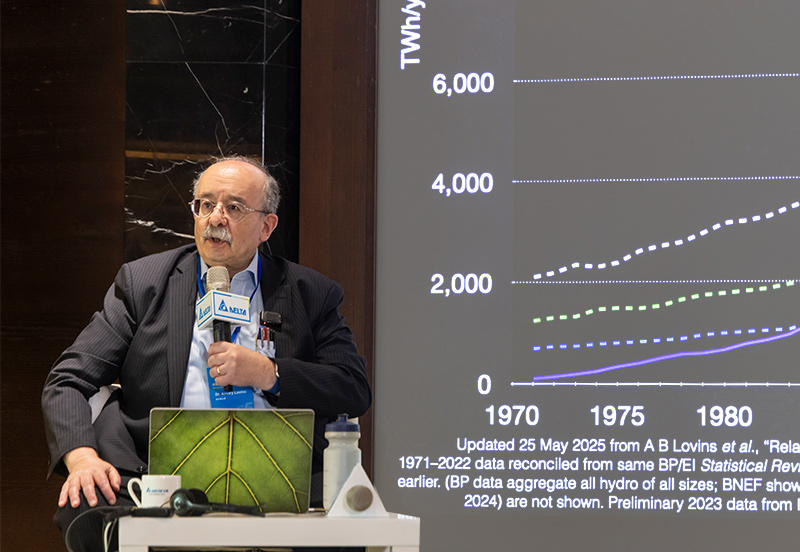
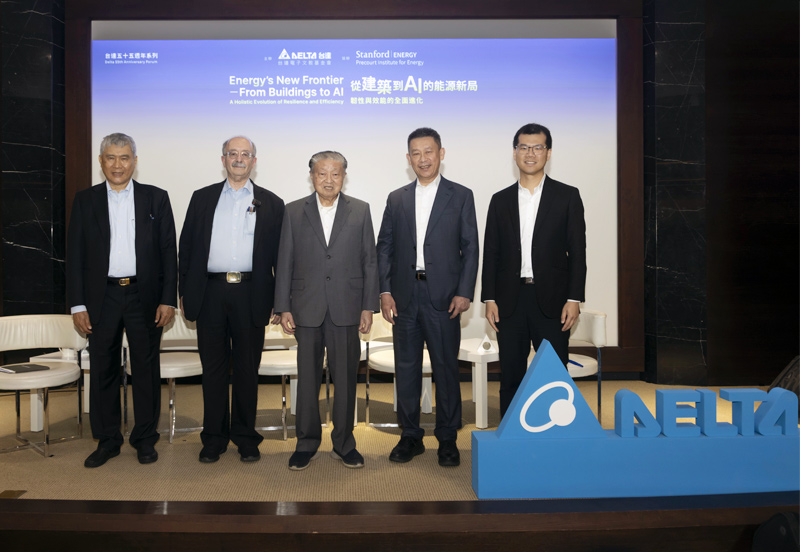
Speaking at Delta’s 55th Anniversary Forum series, “ Energy’s New Frontier: From Buildings to AI” , Dr. Lovins noted that integrated design is not a new technology, but rather a different way of thinking. Traditional engineering design typically begins by optimizing individual components before integrating them. Integrated design, however, reverses this order: it starts with the overall system, defines the desired objectives, and then designs individual components to support goals. It’s the most overlooked part of the four-part energy revolution that’s rapidly shifting the world from inefficient to efficient use, fossil fuels to renewables, fuels to electricity, and centralized to distributed resources. This needs no magic, miracles, or new technologies, but just beginner’s mind, whole-system thinking, rigorously simple design, and meticulous attention to detail—and then getting it implemented needs competition, diplomacy, and relentless patience.
Dr. Lovins pointed out that buildings use three-fourths of US and half of world electricity. He lives in our owner-built house with no heating system, 2200m up in the Rocky Mountains near Aspen, where temperatures used to dip to –44˚C. This house helped inspire several hundred thousand European passive buildings with no heating and roughly normal construction cost. Through integrative design—which improves insulation, optimizes ventilation systems, redesigns lighting —building energy consumption can often be significantly reduced.
Industry uses half the world’s energy. The piping systems connected to these devices are often poorly designed, resulting in unnecessary friction losses. If industrial water pipes were made wider and straighter to virtually eliminate friction, not only could 90% of the electricity be saved, but the large, expensive pumps could be downsized, and unnecessary pumps could even be eliminated.
Data centers also have enormous potential for energy savings. In 2003, when data centers used at least twice as much energy to support servers as to operate them, RMI convened >90 industry experts and found ways to save ~89% of that usual energy use, probably with lower capex, faster construction, and better throughput and uptime. Savings occurred at many levels—system architecture, software, compiling, devices, and utilities.
Global energy efficiency roughly doubled from Neolithic times to 1820, then tripled again, but now it can double again with conventional methods, and about triple again by adding “integrative design”— proven ways to optimize buildings, vehicles, and factories as whole systems. That is, the sextupling of global energy efficiency can now be approximately repeated, to great economic and security advantage. Hundreds of practical examples suggest this method’s strong value for Taiwan’s development and resilience.
In the process of energy transition, in addition to improving energy efficiency through integrative design, the use of renewable energy is also critical to strengthen energy security. Bloomberg (New Energy Finance) estimated renewables in 2023 were the cheapest choice to make half to two-thirds the world’s bulk electricity serving three fifths of global GDP including Europe, India, China, and Brazil. Although a common concern about renewable energy is its variability, variability does not equate to unreliability. Through forecasting technologies, energy storage systems, and demand response management, a grid powered primarily by renewable energy can operate just as reliably—and this is precisely the reliable, clean electricity needed in the age of AI.
The key to the energy transition lies in designing and utilizing energy systems more intelligently. Delta is committed to improving energy efficiency by providing power and thermal management solutions from grid to chip and helping AI data centers enhance energy efficiency. Additionally, through microgrids, Delta integrates renewable energy, hydrogen fuel cells, and energy storage to intelligently dispatch power sources and strengthen grid resilience. Our commitment to improving energy efficiency has supported our business growth, reflecting Dr. Lovins’ philosophy that companies can achieve both profitability and sustainability. Since reaching peak carbon emissions in 2017, Delta has steadily reduced emissions beginning in 2018 while revenue continued to grow, demonstrating a clear decoupling of business growth from carbon emissions. Echoing Dr. Lovins’ reminder to “be fruitful and subtract,” let us move forward together by embracing a subtraction mindset to achieve shared sustainability and build a better tomorrow.
Post time: Aug-07-2026


